
Corporate law is one of the most popular career choices for law aspirants because it offers strong growth, business exposure, and opportunities to work with companies, startups, law firms, banks, investors, and multinational organizations.
If you are wondering how to become a corporate lawyer in India, the path starts with choosing law after Class 12 or graduation, clearing a law entrance exam, joining a good law college, studying subjects like Contract Law and Company Law, doing corporate internships, and building drafting, research, negotiation, and commercial awareness skills.
A corporate lawyer advises businesses on contracts, mergers, compliance, investments, disputes, governance, and legal risks.
How to Become a Corporate Lawyer in India?
Becoming a corporate lawyer in India requires the right law degree, practical internships, strong legal skills, business understanding, and consistent career planning. Students can enter this field through a 5-year integrated law course after Class 12 or a 3-year LL.B. course after graduation. Here is the complete step-by-step process.
Step 1: Choose the Right Route: After 12th or After Graduation
The first step is to decide your entry route. If you are in Class 12 or have just passed school, you can choose a 5-year integrated law course like BA LL.B., BBA LL.B., or B.Com LL.B.
If you have already completed graduation in another field, you can choose a 3-year LL.B. course and still build a strong corporate law career.
Step 2: Prepare for the Right Law Entrance Exams
For 5-year law courses after Class 12, students should prepare for exams like CLAT, AILET, SLAT, LNAT, MH CET Law, CUET Law, and other university-level law entrance exams.
For 3-year LL.B. after graduation, students can target entrance routes like NLSAT-LLB for NLSIU Bengaluru’s 3-year LL.B. (Hons.) program, CUET PG Law, DU LL.B. admission routes, MH CET Law 3-year LL.B., TS LAWCET, AP LAWCET, and other state or university-level exams.
Step 3: Get Admission into a Good Law College
The law college you choose can strongly affect your internships, peer group, alumni network, placements, and corporate exposure. For 5-year law, top NLUs like NLSIU Bangalore, NALSAR Hyderabad, and WBNUJS Kolkata are among the strongest choices for students targeting corporate law.
Other top NLUs, reputed private law schools, and strong state law colleges also provide good opportunities if students actively build skills and internships.
Step 4: Study Core Corporate Law Subjects Seriously
Corporate law is built on strong command over business-related legal subjects. During law school, focus deeply on:
- Contract Law
- Company Law
- Securities Law
- Banking and Finance Law
- Competition Law
- Taxation Law
- Labour Law
- Intellectual Property Rights
- Insolvency and Bankruptcy Code
- Arbitration Law
- Mergers and Acquisitions
These subjects help you understand how companies are formed, funded, regulated, managed, and protected legally.
Step 5: Build Practical Corporate Law Skills
A corporate lawyer must know more than theory. Start building skills like contract drafting, legal research, due diligence, legal writing, negotiation, client communication, commercial awareness, and basic financial understanding.
Learn how to read agreements, identify legal risks, understand business terms, and explain legal issues clearly. These practical skills make you useful during internships and job interviews.
Step 6: Do Internships with Law Firms, Companies, and Startups
Internships are one of the most important parts of becoming a corporate lawyer. In the early semesters, you can intern with NGOs, trial courts, small law offices, or research organizations.
Later, target corporate law firms, boutique firms, in-house legal teams, startups, banks, and companies. Try to work on contracts, compliance, due diligence, research notes, investment documents, and company law assignments.
Step 7: Build a Strong CV, Portfolio, and Network
Corporate law firms and companies look for students who show consistent interest in business law. Build a strong CV with internships, research papers, publications, moot court participation, contract drafting courses, corporate law certifications, and relevant projects.
Also maintain a professional LinkedIn profile and connect with seniors, lawyers, recruiters, alumni, and internship coordinators. Networking can help you discover internships and job openings faster.
Step 8: Apply for Corporate Law Jobs and Keep Specializing
After graduation, apply for roles in Tier-1 law firms, mid-sized corporate firms, boutique firms, in-house legal teams, startups, banks, NBFCs, consulting firms, compliance teams, and legal process outsourcing companies.
Entry-level roles may include legal associate, legal trainee, contract analyst, compliance associate, or in-house legal executive. As you gain experience, specialize in areas like M&A, private equity, capital markets, banking, IBC, competition law, data protection, or arbitration.
Who is a Corporate Lawyer?
A corporate lawyer is a legal professional who advises companies, startups, investors, business owners, banks, and organizations on legal matters related to business operations. In simple terms, a corporate lawyer helps businesses follow the law, avoid legal risks, draft agreements, close deals, manage compliance, and handle disputes.
They work on areas like contracts, company law, mergers and acquisitions, investment transactions, employment issues, intellectual property, taxation, arbitration, and regulatory approvals. Corporate lawyers may work in law firms, in-house legal teams, consulting firms, startups, banks, NBFCs, or large multinational companies.
What Do Corporate Lawyers Do?
Corporate lawyers handle the legal side of business decisions. Their work changes depending on whether they work in a law firm, company, startup, bank, or consulting setup.
Common work handled by corporate lawyers includes:
- Drafting and reviewing contracts
- Preparing shareholder agreements
- Advising on company formation and business structure
- Handling mergers and acquisitions
- Conducting legal due diligence
- Advising on investment and funding deals
- Managing company law compliance
- Reviewing employment agreements
- Advising on intellectual property rights
- Supporting arbitration and commercial disputes
- Preparing legal opinions for business decisions
- Assisting with regulatory approvals
- Advising startups on founder agreements and investor terms
- Reviewing vendor, client, and partnership agreements
- Helping companies reduce legal and financial risks
- Working with finance, HR, operations, and leadership teams
- Ensuring businesses follow applicable laws and regulations
Why Corporate Law is a Popular Career in India?
1. Strong Demand from Companies and Startups
India has a growing startup ecosystem, expanding private sector, active investment market, and increasing compliance requirements. This creates regular demand for corporate lawyers who can handle contracts, funding deals, governance, employment matters, regulatory filings, and business risk management.
2. Better Salary Potential in Law Firms and Companies
Corporate law often offers better early-career salary potential compared to many traditional legal paths. Tier-1 law firms, corporate law firms, banks, consulting companies, and in-house legal teams offer attractive packages to skilled lawyers with good drafting, research, and commercial understanding.
3. Direct Exposure to Business Decisions
Corporate lawyers do not work only on legal theory. They are directly involved in business decisions such as acquisitions, investments, partnerships, vendor contracts, product launches, compliance planning, and risk management. This makes the career practical, dynamic, and business-oriented.
4. Opportunity to Work with Big Brands and Investors
A corporate lawyer may work with listed companies, multinational corporations, private equity funds, venture capital firms, banks, unicorn startups, and growing businesses. This exposure helps lawyers understand how major financial and commercial transactions actually happen.
5. Multiple Career Routes After Law School
Corporate law gives students several career options. They can join law firms, boutique corporate firms, in-house legal teams, startups, banks, NBFCs, consulting firms, compliance teams, legal process outsourcing companies, or later move into policy, business strategy, or entrepreneurship.
6. Skill-Based Growth, Not Just Seniority-Based Growth
In corporate law, lawyers who are good at drafting, negotiation, deal understanding, client communication, and commercial problem-solving can grow faster. Strong practical skills, internships, and specialization often matter as much as years of experience.
7. High Relevance in Modern Business and Regulation
Businesses today deal with data protection, employment rules, tax structures, investment regulations, intellectual property, consumer laws, ESG requirements, competition issues, and contract risks. Corporate lawyers are needed to help companies operate safely in this complex legal environment.
How to Become a Corporate Lawyer After Class 12th?
Students who want to become corporate lawyers after Class 12 should choose the 5-year integrated law route. The process is simple if planned early.
- Choose any stream in Class 11–12: Arts, Commerce, Science, or Humanities.
- Start preparing for law entrance exams like CLAT, AILET, SLAT, LNAT, MH CET Law, and CUET Law.
- Target a strong 5-year law course such as BA LL.B., BBA LL.B., or B.Com LL.B.
- Try to get admission into a top law college, preferably an NLU or a reputed private/state law school.
- Focus on Contract Law, Company Law, Securities Law, Taxation Law, IBC, Arbitration, and IPR.
- Do internships with law firms, companies, startups, banks, and corporate legal teams.
- Build practical skills like drafting, legal research, negotiation, due diligence, and commercial awareness.
- Apply for corporate law roles during final-year placements, PPOs, or direct job applications.
How to Become a Corporate Lawyer After Graduation?
Graduates from any stream can also become corporate lawyers by pursuing a 3-year LL.B. course from a recognized law college.
- Complete graduation in any discipline from a recognized university.
- Prepare for 3-year LL.B. entrance exams such as NLSAT-LLB, CUET PG Law, DU LL.B. admission route, MH CET Law 3-year LL.B., TS LAWCET, AP LAWCET, and university-level law tests. NLSIU’s official admissions page states that admission to its 3-year LL.B. is through NLSAT-LLB.
- Join a recognized 3-year LL.B. program with strong academic and internship exposure.
- Study core corporate law subjects like Contract Law, Company Law, Taxation, IBC, Arbitration, Banking Law, and IPR.
- Take practical certificate courses in contract drafting, M&A, company law, securities law, and due diligence.
- Do internships with corporate law firms, in-house legal teams, startups, banks, and compliance teams.
- Build a strong CV with internships, publications, drafting samples, and corporate law projects.
- Apply for entry-level roles such as legal associate, legal trainee, contract analyst, or compliance associate.
Best Law Courses to Become a Corporate Lawyer in India
| Course | Duration | Why It Helps in Corporate Law |
| BA LL.B. | 5 years | Builds legal foundation with strong understanding of society, rights, governance, and public policy |
| BBA LL.B. | 5 years | Combines law with management subjects, making it useful for contracts, companies, startups, and business transactions |
| B.Com LL.B. | 5 years | Helpful for corporate law, tax law, securities law, banking, finance, and commercial transactions |
| B.Sc LL.B. | 5 years | Useful for technology law, patents, data protection, environmental law, and technical regulatory areas |
| 3-Year LL.B. | 3 years | Best route for graduates who decide to pursue corporate law after completing another degree |
| LL.M. in Corporate Law | 1–2 years | Helps in deeper specialization, academics, research, policy, or advanced corporate law roles |
| Certificate Courses in Corporate Law | Few weeks to months | Useful for practical skills like drafting, M&A, company law, securities law, IBC, and due diligence |
Best Law Entrance Exams for Corporate Law Aspirants
| Entrance Exam | Course Route | Key Colleges / Universities |
| CLAT UG | 5-year integrated LL.B. | Participating NLUs through CLAT |
| AILET | 5-year BA LL.B. | National Law University Delhi |
| SLAT | 5-year BA LL.B. / BBA LL.B. | SLS Pune, Noida, Hyderabad, Nagpur |
| LNAT | 5-year law programs | Jindal Global Law School and other LNAT-accepting institutions |
| MH CET Law 5-Year | 5-year integrated LL.B. | GLC Mumbai, ILS Pune, and other Maharashtra colleges |
| CUET Law / CUET UG | 5-year law programs | Universities accepting CUET scores |
| NLSAT-LLB | 3-year LL.B. | NLSIU Bengaluru 3-year LL.B. |
| MH CET Law 3-Year | 3-year LL.B. | Maharashtra law colleges offering 3-year LL.B. |
| TS LAWCET / AP LAWCET | 3-year and 5-year law courses | State law colleges in Telangana and Andhra Pradesh |
| University-Level Law Tests | 3-year or 5-year law courses | Individual universities and private law schools |
Best Law Colleges for Corporate Law in India
| Law College | Location | College Type |
| National Law School of India University | Bengaluru | NLU |
| NALSAR University of Law | Hyderabad | NLU |
| The West Bengal National University of Juridical Sciences | Kolkata | NLU |
| National Law University | Jodhpur | NLU |
| Gujarat National Law University | Gandhinagar | NLU |
| National Law University Delhi | New Delhi | NLU |
| Jindal Global Law School | Sonipat | Private Law School |
| Symbiosis Law School | Pune | Private Law School |
| Government Law College | Mumbai | State Law College |
| ILS Law College | Pune | State/Private-Aided Law College |
| Faculty of Law, University of Delhi | Delhi | Central University |
| Christ University School of Law | Bengaluru | Private Law School |
Skills Required to Become a Corporate Lawyer
Corporate law is a practical, skill-driven field. A student must understand law, but must also know how businesses work, how deals are structured, and how legal risks are handled.
| Skill | Why It Matters for Corporate Lawyers |
| Contract Drafting | Corporate lawyers regularly draft, review, and negotiate agreements. Strong drafting helps avoid vague clauses, business risks, and future disputes. |
| Legal Research | Lawyers must interpret statutes, rules, regulations, judgments, and notifications before advising clients or companies on legal issues. |
| Due Diligence | In mergers, acquisitions, funding, and investment deals, lawyers review company documents to identify legal, financial, regulatory, and contractual risks. |
| Commercial Awareness | Corporate lawyers must understand business goals, industry risks, revenue models, market trends, and the commercial impact of legal decisions. |
| Negotiation Skills | Lawyers negotiate contracts, investment terms, settlements, employment clauses, vendor agreements, and deal documents on behalf of clients or companies. |
| Communication Skills | Corporate lawyers must explain complex legal issues clearly to founders, management teams, investors, clients, and non-legal departments. |
| Legal Writing | Clear writing is needed for legal opinions, emails, research notes, board documents, compliance reports, and transaction summaries. |
| Attention to Detail | Small mistakes in dates, clauses, definitions, payment terms, or compliance requirements can create serious legal and financial risks. |
| Financial Literacy | Understanding balance sheets, shareholding, valuation, debt, equity, revenue, and investment terms helps in M&A, funding, and corporate transactions. |
| Problem-Solving | Corporate lawyers are expected to find practical legal solutions, not just point out problems. Business teams need clear, workable advice. |
| Time Management | Corporate law often involves strict deadlines, urgent closings, regulatory filings, and multiple documents moving at the same time. |
| Compliance Understanding | Lawyers must help businesses follow company law, labour law, tax rules, data protection norms, SEBI rules, RBI regulations, and sector-specific laws. |
| Team Collaboration | Corporate lawyers work with finance, HR, operations, founders, investors, external counsel, auditors, and business teams. |
| Technology Awareness | Modern corporate lawyers must understand legal tech, contract management tools, data protection, AI, cybersecurity, and digital business risks. |
Corporate Lawyer Salary in India
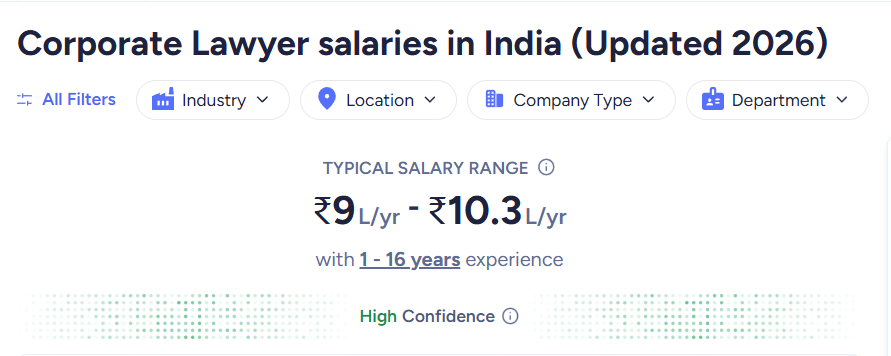
The average salary of a corporate lawyer in India ranges from ₹9 LPA to ₹10.3 LPA.
| Experience / Role Level | Average Salary Range in India |
| Fresher / Legal Trainee | ₹3 lakh – ₹6 lakh per year |
| Junior Corporate Lawyer / Associate | ₹6 lakh – ₹12 lakh per year |
| Mid-Level Associate / Legal Counsel | ₹12 lakh – ₹25 lakh per year |
| Senior Associate / Senior Legal Counsel | ₹25 lakh – ₹45 lakh per year |
| Principal Associate / Managing Associate | ₹40 lakh – ₹70 lakh+ per year |
| Partner / General Counsel / Head Legal | ₹70 lakh – ₹1 crore+ per year |
A realistic starting salary for a corporate lawyer can be much higher in top-tier law firms, especially for graduates from top NLUs and strong law schools.
FAQs About How to Become a Corporate Lawyer
Can I become a corporate lawyer after graduation?
Yes, graduates from any stream can become corporate lawyers by pursuing a 3-year LL.B. course from a recognized law college. After that, they should build expertise in contracts, company law, taxation, IBC, arbitration, M&A, compliance, and corporate internships.
Is CLAT necessary to become a corporate lawyer?
CLAT is not compulsory to become a corporate lawyer, but it is highly useful if you want admission to top NLUs. Students can also become corporate lawyers through AILET, SLAT, LNAT, MH CET Law, CUET Law, NLSAT-LLB, DU LL.B., and other law entrance routes.
Which course is best to become a corporate lawyer?
BBA LL.B. and B.Com LL.B. are strong options for students interested in corporate law because they combine law with business, management, commerce, or finance. BA LL.B. and 3-year LL.B. can also lead to excellent corporate law careers.
Can I become a corporate lawyer without studying in an NLU?
Yes, you can become a corporate lawyer without studying in an NLU. You need strong internships, drafting skills, legal research ability, corporate law certifications, publications, networking, and practical exposure. Many lawyers from non-NLU colleges build successful corporate law careers.
What does a corporate lawyer do daily?
A corporate lawyer may draft contracts, review agreements, advise on compliance, conduct due diligence, prepare legal opinions, support funding deals, help with mergers, negotiate clauses, manage company policies, and work with business teams to reduce legal risks.
Which type of corporate lawyer earns the most?
M&A lawyers, private equity lawyers, capital markets lawyers, banking and finance lawyers, and partners in top law firms usually have higher earning potential. Senior in-house roles like General Counsel or Head Legal can also be highly paid.
Are internships important for becoming a corporate lawyer?
Yes, internships are extremely important. Corporate law firms and companies prefer candidates who have practical exposure to contracts, due diligence, research, compliance, company law, funding documents, and transaction support.
Is corporate law difficult?
Corporate law can be challenging because it involves strict deadlines, detailed documents, business pressure, and complex regulations. However, students who build drafting skills, commercial awareness, and strong legal basics can manage it well.
Is BBA LL.B. better for corporate law?
BBA LL.B. is a good choice for corporate law because it includes business and management subjects along with law. However, BA LL.B., B.Com LL.B., and 3-year LL.B. students can also become successful corporate lawyers with the right skills and internships.